Setup · Sabarmati to Dandi
In 1930, the British colonial state controlled salt production and sale, taxing a necessity used by people across India. After the Indian National Congress declared Purna Swaraj, Gandhi wrote to Viceroy Irwin with grievances and signalled that he would break the salt law. On 12 March, he left Sabarmati Ashram with 78 volunteers for the coast at Dandi. The march turned a law that reached into daily life into a public test of colonial authority and nonviolent discipline.
Gandhi · Decision 1
At Sabarmati, colleagues ask why the campaign should begin with salt rather than a more obviously political demand. Gandhi knows that the British monopoly and tax touch a daily necessity, including the poorest households. He also knows that a visible act must invite participation without inviting violence. The first choice will define what the public thinks civil disobedience is for.

A constitutional demand may be legitimate, but it remains difficult for a farm worker or coastal family to act on directly. The public watches leaders debate terms while their own daily experience is not yet made part of the campaign.
Gandhi’s challenge was not simply to state a grievance; it was to design nonviolent action that people could perform. Salt made the monopoly tangible, while a leaders-only demand would not create the same distributed civil disobedience.
Gandhi · Decision 2
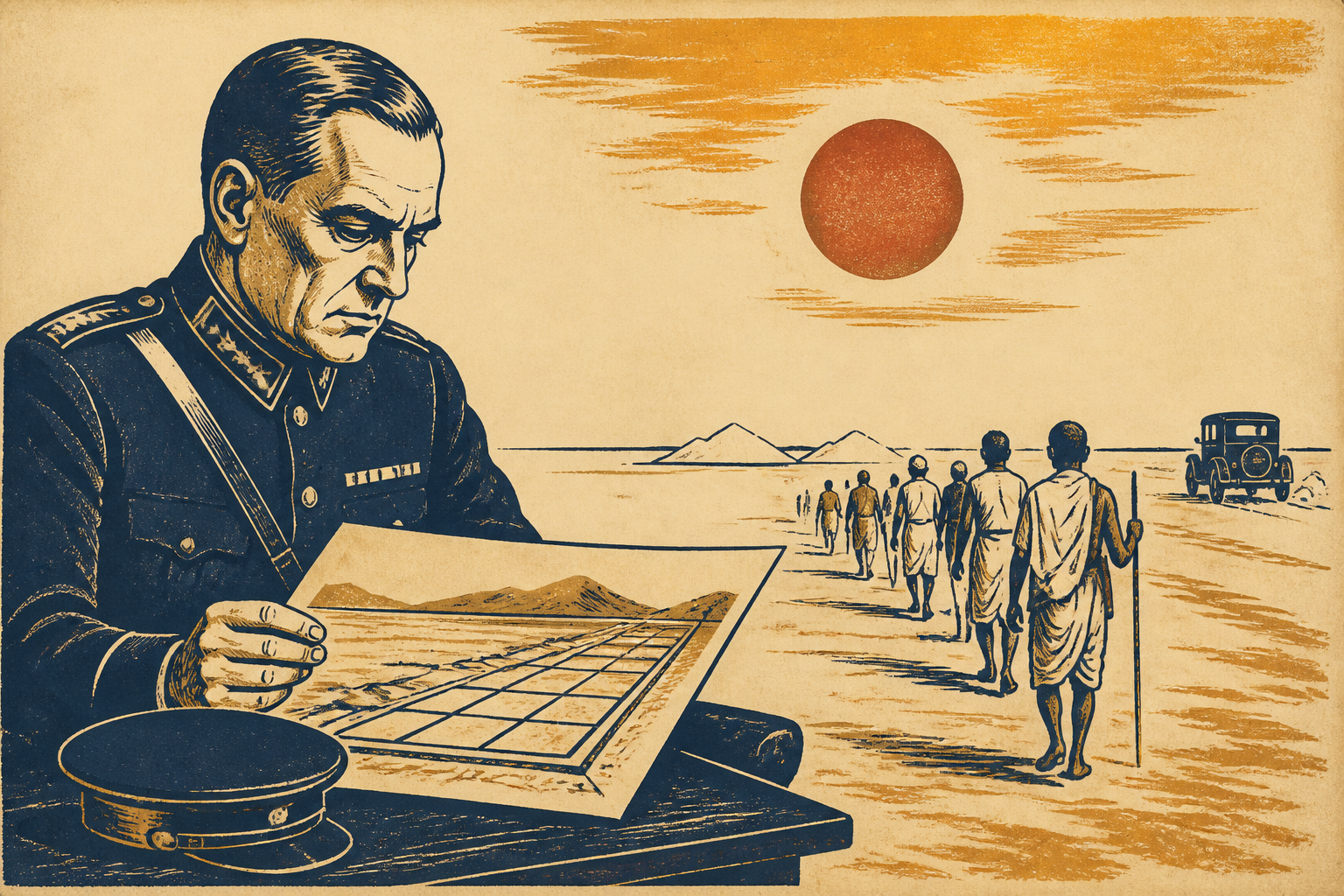
The march has left Sabarmati, gathering attention as it moves through villages toward Dandi. Supporters are angry at the salt law and some expect confrontation when officials respond. Gandhi must decide how firmly to insist on nonviolence when restraint may look slow or weak to impatient followers. His choice will shape whether repression clarifies or obscures the campaign’s message.

If volunteers retaliate, officials can portray the campaign as a public-order threat rather than a principled challenge to an unjust monopoly. People who might have joined a nonviolent act now face a far more dangerous and morally confused situation.
The march’s force depended partly on a visible asymmetry: people openly broke a law while accepting consequences. Violence would not merely change tactics; it would weaken the evidence supporting the campaign’s moral and political argument.

On 6 April at Dandi, Gandhi breached the salt law by collecting natural salt from the shore. The act was intentionally simple enough to be echoed elsewhere, helping launch wider Civil Disobedience. It did not win independence immediately, but it gave the movement a public, reproducible beginning. Gandhi’s arc shows why strategy and discipline were inseparable.

Gandhi’s nonviolent march and the Dandi breach have made it clear that ordinary people can participate; Kesar must judge what form of participation is both meaningful and safe enough for her community.
Kesar · Decision 1
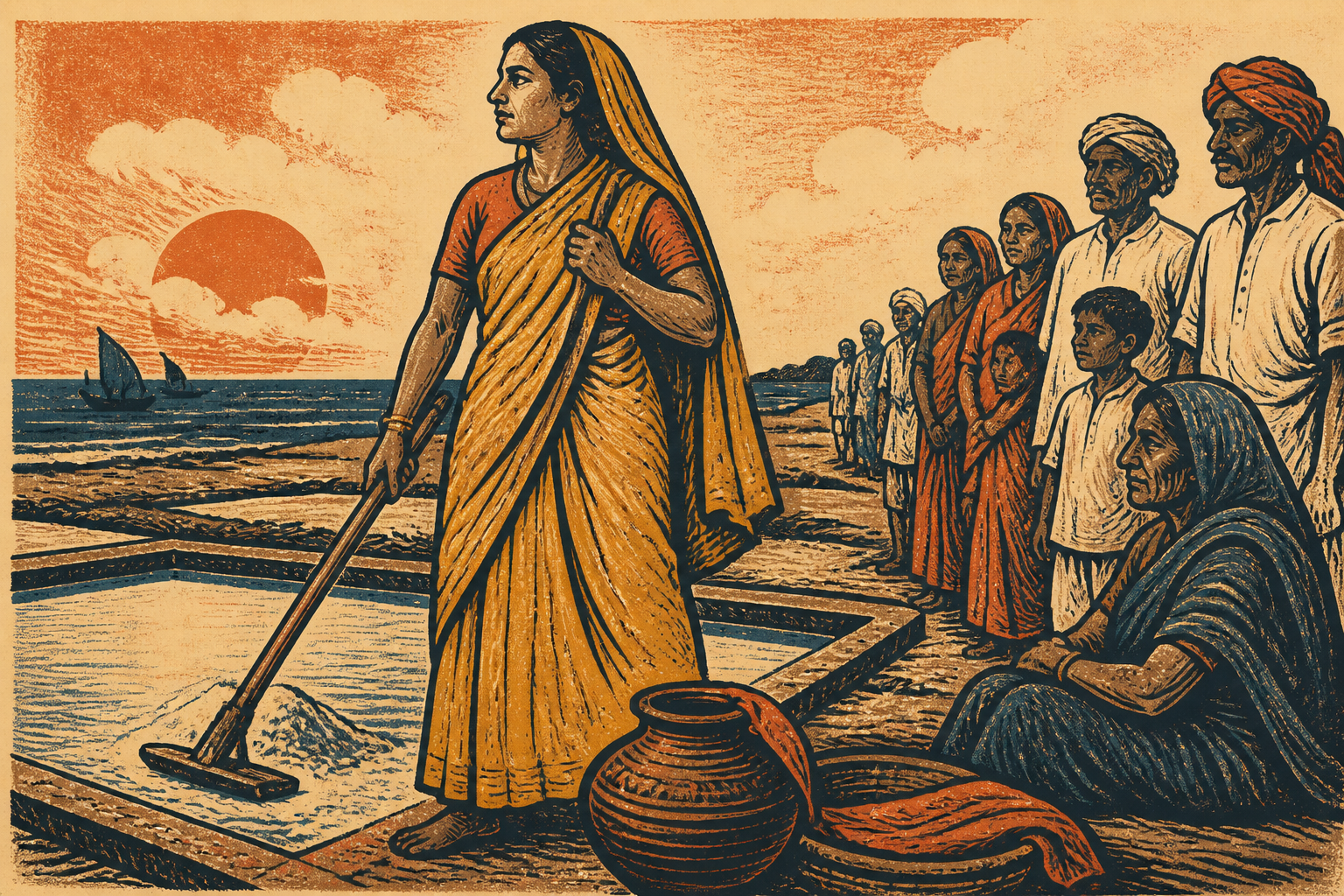
Word reaches Kesar’s village that Gandhi has broken the salt law at Dandi and that people elsewhere are making or collecting salt. Her neighbors want to help, but some fear fines, arrest, and lost income. She can quietly wait to see who wins, or join a public, nonviolent act that connects her household’s need to the larger movement.

By waiting for a settlement, Kesar may protect her household in the short term, yet the salt monopoly remains a private hardship rather than a shared public claim. The campaign’s visibility depends on many people showing that the law reaches beyond political elites.
This does not make fear irrational; repression made participation costly. The historical point is that widespread action, including women’s participation, transformed the Dandi breach from a symbolic moment into a broader civil-disobedience campaign.
Kesar · Decision 2
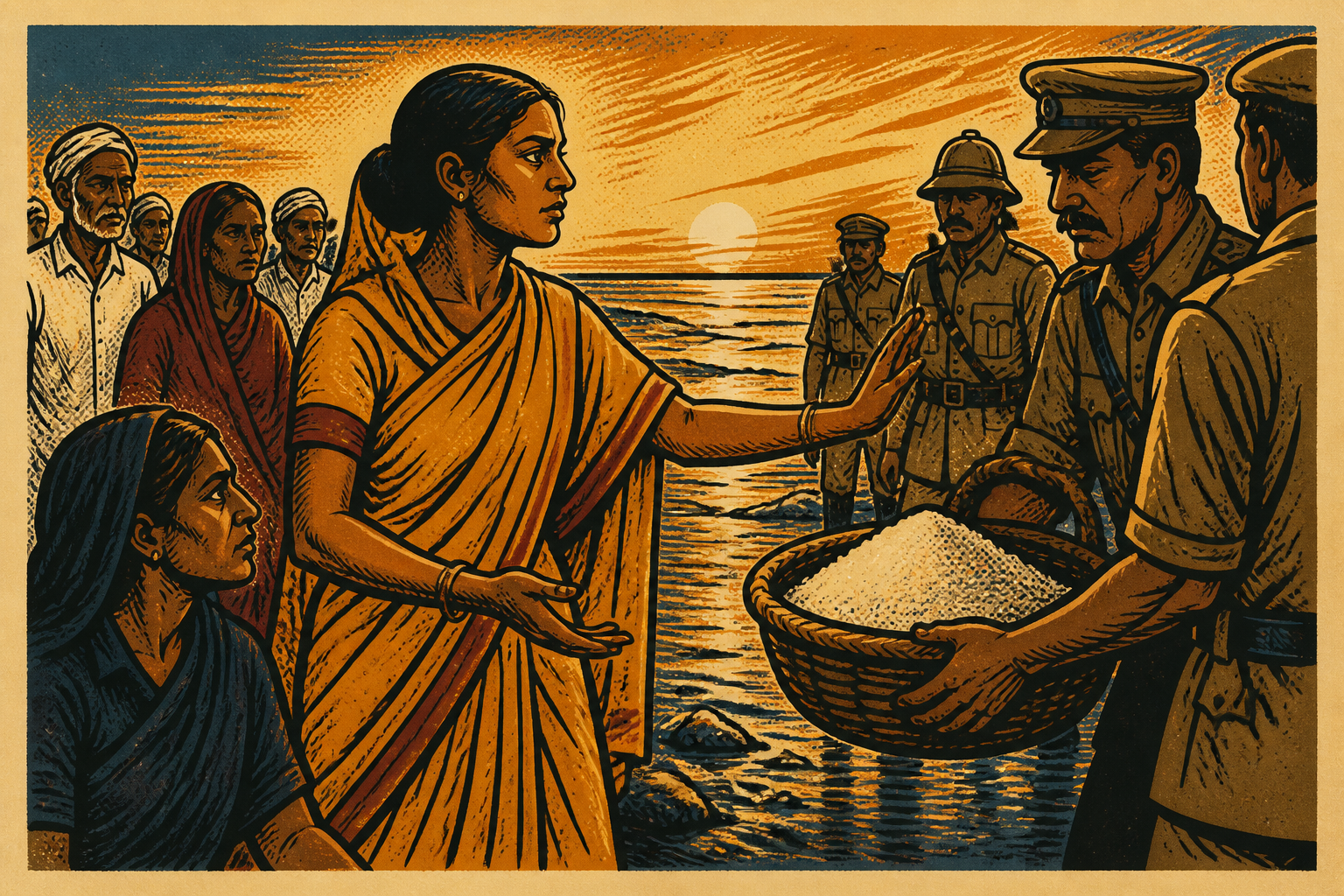
Police arrive as villagers demonstrate and seize salt. A friend urges Kesar to push through the line and destroy government property, arguing that peaceful protest will be ignored. Kesar must decide whether anger should change the campaign’s method.

Once the crowd damages property, the official account can centre on destruction rather than the salt monopoly. Neighbours who might have supported a peaceful action now worry about escalating danger and collective punishment.
The lesson is not that anger at exploitation was illegitimate. It is that the campaign’s leverage depended on disciplined civil disobedience: breaking a law publicly while refusing to make violence the story’s centre.

Kesar’s participation connects the Dandi act to the lives of people who paid the price of the salt monopoly. Across India, people made salt, protested, and faced arrest; participation varied by region, class, and community, so the movement was not uniform. Her arc shows both the reach and the limits of mass action. A march became a campaign because people decided to act beyond the original 78 volunteers.

Gandhi’s Dandi breach and local participation have spread the challenge beyond one location; Collins now observes peaceful law-breaking, wider publicity, and the possibility that force will strengthen the protest’s message.
Edward Collins · Decision 1
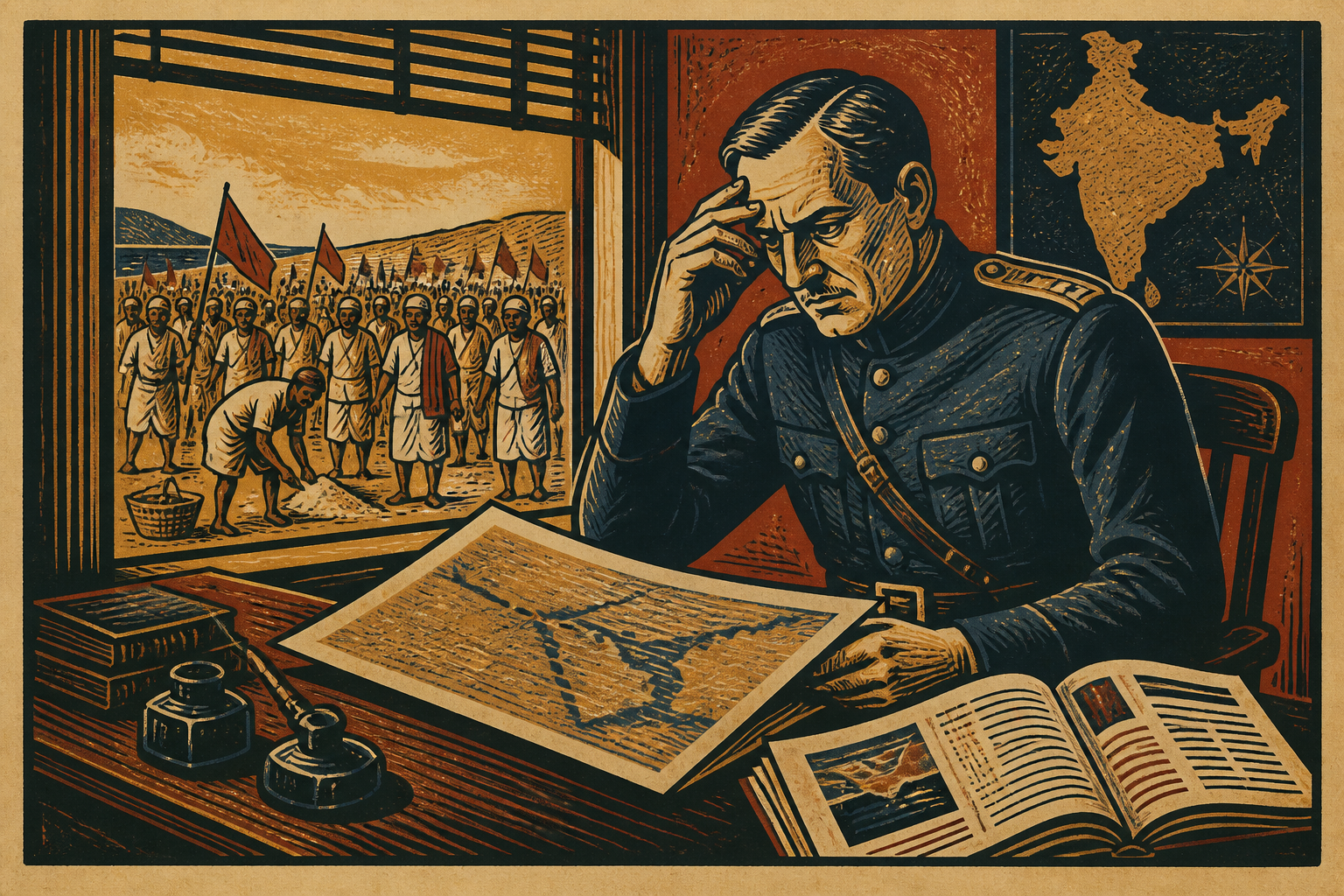
Collins receives reports of villagers making salt and newspapers following the campaign. His superiors expect enforcement, but he notices that the protesters are deliberately public and nonviolent. A sweeping violent response might stop an action in the moment while supplying striking evidence of coercion. He must decide what he tells his superiors about the campaign.

Treating peaceful salt-law breakers as mere criminals may produce arrests, but it also confirms the protesters’ claim that colonial power governs an everyday necessity by coercion. News of enforcement travels further than a quiet administrative report.
The official’s error is analytical as well as ethical. A state can enforce a rule and still lose legitimacy when the rule, the protesters’ conduct, and the response expose a sharp mismatch between law and justice.
Edward Collins · Decision 2
After Gandhi’s arrest in May 1930, volunteers under new leadership plan action at the Dharasana salt works. Collins has seen that removing one leader has not ended the campaign. He can advise that force alone will restore authority, or acknowledge that arrests and repression may widen attention while failing to address the grievance.

Gandhi’s arrest did not prevent other leaders and volunteers from continuing toward Dharasana. When disciplined protesters faced repression, reports of the confrontation could strengthen public and international attention rather than close the story.
This does not mean repression had no immediate impact—it imposed real suffering and fear. It shows why the Salt Satyagraha cannot be explained as one man’s march: its spread depended on a shared grievance, repeatable action, and many participants.

Collins can see a problem no single arrest solves: a colonial law over a basic necessity has become evidence against colonial rule. The Salt March helped make Civil Disobedience a national and international political event, even though the struggle for independence continued until 1947. His arc clarifies that state power and political legitimacy are not the same thing. Enforcement shaped the campaign’s consequences as much as the marchers’ choices did.
Gandhi’s perspective reveals the strategic design: salt joined a universal burden to a repeatable nonviolent act. Kesar’s perspective reveals how the campaign became mass civil disobedience—and why participation carried unequal risks and limits. Collins’s perspective reveals that enforcement and repression could create political costs rather than merely restore order. Together, these viewpoints show that the Salt March was both symbolic communication and practical strategy, a catalyst for a wider movement rather than instant independence.
Review how each decision connected strategy, participation, and state response in the 1930 campaign.